
Version: 1.0
Status: draft for approval
Adopted by the Board on: [date]
Approved by the Supervisory Board on: [date]
Effective from: [date]
Public name: Civilized World Foundation
Abbreviation: CWF
Mission: Make War Obsolete
Policy Plan 2026–2028
1. Introduction
Stichting Civilized World Foundation is being established as an independent Dutch foundation with an international public-benefit mission:
The public expression of this mission is:
Civilized World Foundation starts from the conviction that war is not a law of nature. War is a recurring outcome of human systems: political decision-making, economic incentives, historical enemy images, institutional interests, collective fear, concentration of power, insufficient conflict-prevention mechanisms and limited global public engagement.
CWF does not assume that conflict itself can disappear. Human societies will continue to face disagreements, tensions, competing interests and moral dilemmas. The foundation’s ambition is different: to contribute to a world in which war is no longer considered a logical, acceptable, profitable or necessary instrument for resolving conflict, exercising power or defending interests.
This policy plan describes the foundation’s mission, objectives, activities, governance model, income sources, management of funds, expenditure principles, remuneration policy, integrity safeguards, transparency principles and first implementation priorities for the period 2026–2028.
CWF is being developed as a mission-driven start-up foundation. In the first phase, the foundation requires strong execution capacity: platform development, fundraising, community-building, publication and distribution of the manifesto, communication, stakeholder engagement, governance set-up and operational discipline.
At the same time, a Dutch public-benefit foundation requires independence, financial integrity, accountable decision-making and public transparency. For that reason, CWF consciously separates execution and oversight.
This policy plan is a working document. After incorporation, the first Supervisory Board will review, amend where necessary and formally approve the policy plan.
2. Legal and organisational information
2.1 Name
Legal name: Stichting Civilized World Foundation
Public name: Civilized World Foundation
Abbreviation: CWF
2.2 Registered office
During the start-up phase, the foundation will be based at:
Fluwelen Burgwal 58, Den Haag
The statutory seat will be determined in the deed of incorporation.
2.3 Legal form
Civilized World Foundation will be incorporated as a foundation under Dutch law.
2.4 Status
The foundation is currently in formation. After incorporation, CWF will be registered with the Dutch Chamber of Commerce and will apply for Dutch ANBI status with the Dutch Tax Administration.
ANBI stands for Algemeen Nut Beogende Instelling, a Dutch public-benefit organisation.
2.5 Chamber of Commerce number
Not yet available. This will be added after incorporation.
2.6 RSIN / Dutch tax identification number
Not yet available. This will be added after incorporation.
2.7 Website
cwf.world
2.8 Email address
3. Identity of the foundation
3.1 Mission
Civilized World Foundation aims to contribute to the development, connection and distribution of systemic solutions that can ultimately make war obsolete as a social, political and economic instrument.
Public mission:
3.2 Vision
CWF sees war not as an inevitable fact of human existence, but as a symptom of systems that are insufficiently capable of resolving conflict in a just, timely, peaceful and future-oriented way.
A civilized world, in this view, is not a world without disagreements, conflicts of interest or tensions. It is a world in which human societies have better structures, institutions, narratives, technologies, economic incentives and participatory mechanisms to prevent escalation into violence and war.
Civilized World Foundation aims to contribute to an international movement and knowledge base that makes war increasingly less logical, less attractive, less profitable, less legitimised and ultimately obsolete.
3.3 Core principles
CWF works from the following principles.
1. Public benefit
All activities of the foundation serve the public interest and are not directed at private, commercial, party-political or national interests.
2. Independence
The foundation will not be dominated by one person, organisation, donor, state, company, political party or ideological movement.
3. Systemic approach
War is approached as a systemic problem. CWF therefore focuses on underlying patterns, incentives, institutions, narratives and leverage points.
4. Public legitimacy
A global mission requires public engagement. CWF aims to involve citizens, signatories, governments, civil society organisations, researchers, peace initiatives and other stakeholders in a meaningful and respectful way.
5. Effective execution
The foundation recognises that social impact does not emerge from vision alone. The start-up phase requires professional execution, progress discipline and clear responsibility.
6. Independent oversight
Because the foundation aims to operate effectively, execution must be balanced by independent oversight of public benefit, financial integrity, remuneration, conflicts of interest and public accountability.
7. Transparency
CWF strives for openness about its objective, governance, oversight, finances, donations, activities, remuneration and progress.
8. Integrity
Resources, relationships and decisions must be explainable. The foundation avoids conflicts of interest and maintains a clear separation between private interests, business interests and the interests of the foundation.
9. Non-polarising communication
CWF communicates in a hopeful, dignified, inclusive and careful manner. It seeks connection without being naive about power, violence and geopolitical reality.
4. Objective
4.1 Main objective
The foundation’s objective is to promote peace, international cooperation, public awareness, systemic innovation, education and public participation aimed at preventing, reducing and ultimately making war obsolete as an instrument of conflict resolution, power politics or interest-based action.
4.2 Further elaboration of the objective
The foundation aims to achieve its objective by, among other things:
- developing and distributing an international manifesto aimed at building broad public support for the mission to make war obsolete;
- stimulating public awareness of war as a systemic problem;
- collecting expressions of support from citizens, organisations and other stakeholders;
- developing knowledge, analyses, system maps, scenarios and solution directions;
- connecting existing peace initiatives, researchers, civil society organisations, entrepreneurs, policy thinkers and citizens;
- promoting international dialogue on new institutions, incentives, decision-making mechanisms and preventive structures;
- supporting education, communication and social mobilisation around the question of how war can be made structurally obsolete;
- building an independent, transparent and public-benefit infrastructure for this mission;
- supporting leaders, organisations and institutions that are willing and able to work together on systemic solutions that can make war obsolete.
At this stage, one of the working hypotheses is that such a systemic solution may require a form of global constitutional thinking or an international framework designed to make war obsolete. This remains an area for further exploration, research, dialogue and validation.
4.3 Public-benefit character
The objective of Civilized World Foundation is directed at the public interest. The foundation does not serve the private interests of founders, directors, Supervisory Board members, donors, specific groups or other stakeholders.
The intended social benefits are broad and public in nature, including:
- reducing war and armed conflict;
- promoting peaceful conflict prevention;
- strengthening international cooperation;
- increasing public awareness;
- supporting social and institutional innovation;
- strengthening global civic engagement;
- contributing to a more just and safer world order;
- exploring systemic solutions that can make war obsolete.
The foundation aims for its activities and expenditures to serve the public benefit almost entirely.
5. Governance model: Supervisory Board and executive leadership
5.1 Reason for the chosen model
Civilized World Foundation chooses, in its start-up phase, a governance model with:
- an independent Supervisory Board;
- an executive leadership role;
- professional support in finance, administration, fundraising, community-building and reporting.
This choice is deliberate. In the first years, the foundation primarily requires execution capacity. The mission, first strategy and initial activities are sufficiently clear to begin. What is needed is not primarily more reflection, but professional realisation:
- incorporation and ANBI application;
- website and manifesto;
- signature platform;
- fundraising;
- community-building;
- donation infrastructure;
- privacy and data processes;
- communication;
- stakeholder development;
- first reports and accountability.
A traditional volunteer board with multiple operational portfolios could, in this phase, lead to excessive consultation, fragmented responsibility and insufficient execution capacity.
CWF therefore chooses a start-up-like execution model embedded in public-benefit governance.
5.2 Balance between speed and oversight
The governance of CWF is designed around two principles:
The Executive Director receives a mandate to build, organise and execute within frameworks approved by the Supervisory Board.
The Supervisory Board safeguards that this execution takes place within:
- the statutory objective;
- the public-benefit purpose;
- ANBI requirements;
- the approved budget;
- the remuneration policy;
- the donation policy;
- the conflict-of-interest policy;
- privacy and integrity frameworks;
- public accountability principles.
5.3 Legal structure
The exact legal structure will be determined in consultation with the civil-law notary and, where necessary, an ANBI tax specialist.
The foundation intends to establish a model in which day-to-day leadership is carried out by a Founding Director / Executive Director. The articles of association and internal regulations will determine whether this role is structured as a statutory director under the supervision of the Supervisory Board or as a non-statutory executive director.
In all cases, the following principles apply:
- the executive role is operationally responsible;
- remuneration is not determined by the Executive Director personally;
- the Supervisory Board or competent supervisory body determines remuneration;
- the Executive Director cannot dispose of the foundation’s assets as if they were personal assets;
- major or sensitive decisions require approval;
- conflicts of interest are disclosed, assessed and documented;
- the foundation complies with ANBI requirements regarding control, remuneration, administration and publication.
5.4 Organs and functions
The intended structure includes:
1. Supervisory Board
An independent supervisory body.
2. Founding Director / Executive Director
An executive role responsible for day-to-day leadership and implementation of the approved annual plan.
3. Advisory Board
A non-decision-making international advisory group, to be established when appropriate.
4. External professional support
This may include an accountant, bookkeeper, lawyer, tax specialist, web developer, AI-supported reporting tools, fundraising manager, community manager and other professionals or volunteers.
6. Supervisory Board
6.1 Purpose of the Supervisory Board
The Supervisory Board safeguards the mission, public-benefit character, integrity, financial prudence, remuneration, independence and public legitimacy of the foundation.
The Supervisory Board is not an operational body. It supervises, sets frameworks, approves important decisions and evaluates the functioning of the Executive Director.
6.2 Composition
The foundation aims for a Supervisory Board of at least three independent persons.
The intended areas of expertise are:
1. Chair, Governance & Institutional Integrity
Focus on chairing, governance, role clarity, decision-making, institutional independence, integrity and the effective functioning of the Supervisory Board as a collective.
2. Finance, Audit & Donor Integrity
Focus on budget, annual accounts, financial accountability, donation policy, accountant relationship, financial risks and ANBI principles.
3. Public Legitimacy & Global Mission
Focus on social legitimacy, public communication, international sensitivity, community engagement and mission fidelity.
Depending on growth and complexity, the Supervisory Board may be expanded.
6.3 Tasks of the Supervisory Board
The Supervisory Board is responsible for:
- supervision of mission and objective;
- supervision of compliance with ANBI conditions;
- approval of the policy plan, annual plan and budget;
- approval of annual accounts and financial accountability;
- adoption or approval of the remuneration policy;
- determination of the remuneration of the Executive Director;
- appointment, evaluation, suspension and dismissal of the Executive Director, where legally applicable;
- oversight of donation policy and donor integrity;
- oversight of conflicts of interest;
- approval of major or sensitive financial obligations;
- oversight of public legitimacy and reputational risks;
- oversight of privacy, data processing and the signature platform;
- annual evaluation of governance and executive leadership.
6.4 Independence
Members of the Supervisory Board operate independently from:
- the founder;
- the Executive Director;
- donors;
- funders;
- political organisations;
- commercial suppliers;
- related companies;
- public constituencies or specific interest groups.
Members disclose potential conflicts of interest in advance. In the event of a conflict of interest, the relevant member does not participate in deliberation or decision-making on the matter concerned.
6.5 Remuneration of the Supervisory Board
Members of the Supervisory Board do not receive a salary for their supervisory work.
The foundation may reimburse reasonable and actually incurred expenses. In addition, if appropriate within the financial position of the foundation and ANBI rules, the foundation may grant modest, non-excessive attendance fees for preparing and attending meetings.
In the start-up phase, the principle is sobriety. No remuneration or compensation will be introduced unless and until CWF has sufficient financial resources to do so responsibly. Until that moment, all work for the foundation is performed pro bono, unless the Supervisory Board explicitly and justifiably decides otherwise within the applicable legal and ANBI framework.
7. Founding Director / Executive Director
7.1 Reason for an executive leadership role
The foundation chooses an executive leadership role because the start-up phase requires substantial practical, operational and entrepreneurial capacity.
In a short period of time, the foundation must:
- be legally and fiscally established;
- apply for ANBI status;
- build a digital platform;
- publish a manifesto;
- attract signatories;
- set up a donation infrastructure;
- start fundraising;
- build a community;
- approach partners and advisors;
- develop communication;
- organise reporting and accountability.
These activities require structural availability, responsibility and professional execution capacity. It is neither realistic nor desirable to make this core execution fully dependent on volunteer board members.
The choice for a Founding Director / Executive Director is therefore not a deviation from the public-benefit purpose, but a means to realise that purpose effectively and professionally.
7.2 Function title
The intended function title is:
Founding Director / Executive Director
The Dutch designation may be:
Uitvoerend Directeur
7.3 Main assignment
The Founding Director is responsible for building the foundation during the first policy period and for executing the annual plan approved by the Supervisory Board.
The main assignment is:
7.4 Core responsibilities
The Founding Director is responsible for:
1. Incorporation and basic set-up
- preparing incorporation;
- coordinating with notary, tax specialist and accountant;
- preparing the ANBI application;
- setting up the basic administration;
- preparing governance documents;
- organising the first reporting cycle.
2. Strategic execution
- translating the mission into an annual plan;
- prioritising activities;
- monitoring progress;
- reporting to the Supervisory Board;
- preparing decision-making.
3. Website and manifesto platform
- developing cwf.world and related digital infrastructure;
- publishing the manifesto and explanation;
- realising signature functionality;
- ensuring privacy and data processes;
- testing and improving the user experience.
4. Fundraising
- developing the fundraising strategy;
- building the donor pipeline;
- approaching funds, donors and partners;
- preparing grant applications;
- developing the donation proposition;
- safeguarding donor integrity.
5. Community-building
- attracting and activating signatories;
- developing updates, newsletters and public communication;
- identifying ambassadors;
- stimulating international engagement;
- organising feedback loops from society.
6. Partnerships and network
- approaching experts, institutions and civil society partners;
- building an Advisory Board or advisory circle;
- connecting existing initiatives;
- preparing collaborations.
7. Management of support
- managing accountants, bookkeepers, lawyers, tax specialists, freelancers, web developers, AI tools and other supporters;
- preparing the future involvement of a Funding Manager or Community Manager;
- monitoring quality, planning and budget.
8. Transparency and reporting
- preparing the activity report;
- preparing financial reporting;
- publishing ANBI information;
- communicating progress to donors, signatories and the public.
7.5 Mandate and limitations
The Founding Director has a mandate to perform day-to-day activities within:
- the articles of association;
- this policy plan;
- the annual plan;
- the budget;
- the executive regulations;
- the authorisation rules;
- the donation policy;
- the conflict-of-interest policy;
- the privacy and data policy.
The Founding Director requires prior approval for:
- expenditures above a threshold to be determined by the Supervisory Board;
- entering into multi-year obligations;
- contracts with related parties;
- hiring employees or structural freelancers outside the approved budget;
- accepting large, anonymous or reputationally sensitive donations;
- changes to the mission, manifesto or core positioning;
- major public campaigns;
- entering into strategic partnerships;
- transactions in which a conflict of interest may arise.
7.6 Remuneration of the Founding Director
The Founding Director may receive appropriate and market-conform remuneration for actual executive work, but only if and when the foundation has sufficient financial resources.
Until that moment, the work of the Founding Director is performed pro bono.
Remuneration is determined by the Supervisory Board or the competent supervisory body. The Founding Director does not participate in decision-making about their own remuneration, employment conditions, assignment terms or compensation.
When determining remuneration, at least the following criteria are considered:
- scope of the role;
- phase of development of the foundation;
- available financial resources;
- complexity of the assignment;
- responsibilities and risks;
- required expertise;
- market conformity;
- sobriety;
- public explainability;
- relationship between execution costs and spending on the foundation’s objective;
- relevant sector standards for charities, where appropriate.
In the start-up phase, CWF may choose:
- a part-time employment contract;
- a temporary employment contract;
- a service or management agreement, if legally and fiscally appropriate;
- a growth model in which remuneration develops in line with structural income and the scale of activities.
Remuneration is reported transparently in the annual accounts and, where required or appropriate, on the ANBI publication page.
7.7 If the founder becomes Founding Director
If the founder is appointed as Founding Director, additional safeguards apply:
- the appointment is decided exclusively by independent supervisors;
- the founder does not participate in decision-making about their own appointment, remuneration or contract terms;
- the job description is recorded in writing;
- remuneration is externally or objectively tested for reasonableness and market conformity;
- the assignment is evaluated periodically, for example annually;
- deliverables are determined in advance;
- payments to the founder or related companies are separately disclosed and assessed;
- contracts with related parties are entered into only after explicit decision-making and market-conformity review;
- public accountability is provided regarding role, remuneration and governance safeguards.
The purpose of these safeguards is to prevent the foundation, in fact or appearance, from functioning as an extension of the private or business interests of the founder.
8. Professional support
8.1 Accountant and financial administration
The foundation works with an accountant, bookkeeper or administration office for financial administration, annual accounts and financial accountability.
This professional support may include:
- setting up the administration;
- processing income and expenses;
- periodic reporting;
- annual accounts;
- financial accountability for ANBI publication;
- tax obligations;
- payroll administration if employees are hired.
The Supervisory Board remains responsible for supervising financial prudence. The Executive Director remains responsible for timely and accurate delivery of information.
8.2 AI-supported reporting
The foundation may use AI tools for efficiency in reporting and document management.
AI tools may be used for:
- draft minutes;
- decision lists;
- action lists;
- meeting summaries;
- follow-up of actions;
- preparation of Supervisory Board packs;
- draft texts for reports.
AI tools do not replace formal decision-making and do not carry governance responsibility.
Formal responsibility for reporting, approval of decisions and archiving remains with the designated person or competent body.
8.3 Funding Manager
When the scale and financial position of the foundation justify it, the foundation may appoint a paid Funding Manager.
Tasks may include:
- building a donor pipeline;
- grant research;
- writing funding applications;
- managing donor relationships;
- developing recurring donations;
- supporting major donor conversations;
- safeguarding donor communication;
- reporting on fundraising results.
The foundation preferably does not use a purely commission-based model linked to donations raised. Fundraising must be consistent with integrity, donor trust and independence.
8.4 Community Manager
When the manifesto platform gains traction, the foundation may appoint a paid Community Manager.
Tasks may include:
- relations with signatories;
- newsletters and updates;
- ambassador programme;
- international community-building;
- social sharing;
- collecting feedback;
- bringing signals from society back to executive leadership and supervision;
- supporting public campaigns.
This role will also be based on a clear job description, budget, market conformity and demonstrable contribution to the foundation’s objective.
9. Activities
9.1 Activities in the first policy period
The first policy period focuses on incorporation, legitimacy, infrastructure, public visibility, fundraising and building an initial international base.
In 2026–2028, the foundation will focus on the following main activities.
9.2 Publication and distribution of the manifesto
Civilized World Foundation develops, publishes and maintains a manifesto in which the principles behind the mission to make war obsolete are set out.
Activities include:
- formulating and refining the manifesto;
- publishing the manifesto on cwf.world;
- developing accessible public explanations;
- translating the manifesto into multiple languages when the foundation is able to do so;
- inviting citizens worldwide to sign the manifesto;
- offering shareable communication formats for social media and networks.
The manifesto is intended as a starting point for public awareness, mobilisation and dialogue. Signing the manifesto means support for the mission. It does not mean that signatories are legally, politically or organisationally bound to the foundation.
9.3 Signature platform and public support
The foundation aims to develop a digital platform through which people can sign the manifesto.
Activities include:
- developing a secure and user-friendly signature form;
- processing personal data carefully;
- providing clear information about privacy, visibility and communication;
- offering the option to make a signature publicly visible or not visible;
- separating manifesto signature from subscription to updates or newsletters;
- providing insight into public support, for example by country or region, without unnecessarily publishing personal data.
The foundation does not view signatories as a marketing database, but as citizens expressing public support for the mission.
9.4 Community-building
Civilized World Foundation aims to build an international community of signatories, supporters, ambassadors, experts, academic and civil society partners.
Activities include:
- periodic updates to interested persons;
- invitations to dialogue, feedback and participation;
- development of ambassadorship;
- stimulation of local and international involvement;
- organisation of online meetings, conversations or working sessions;
- collection of questions, ideas, concerns and suggestions from society;
- bringing relevant signals back to executive leadership and the Supervisory Board.
Community-building will be designed carefully. CWF aims to make public participation meaningful and to avoid participation becoming merely symbolic.
9.5 Knowledge development and systems analysis
The foundation aims to contribute to knowledge development about war as a systemic problem and about possible solution directions.
Activities include:
- developing an initial system map around war, conflict prevention and escalation mechanisms;
- collecting existing knowledge from peace and conflict studies, international relations, systems thinking, behavioural science, governance, economics, technology and law;
- publishing accessible analyses;
- identifying leverage points for system change;
- developing scenarios, roadmaps and research questions;
- collaborating with experts, universities, think tanks or civil society organisations where appropriate.
The foundation does not claim to possess all knowledge itself. It aims to connect knowledge, make it accessible and direct it towards systemic change.
9.6 Public communication and education
The foundation aims to contribute to public awareness around the question of how war can be made structurally obsolete.
Activities include:
- publishing articles, essays, videos, visualisations or explainers;
- developing educational content;
- explaining clearly why war is a systemic issue;
- connecting moral, institutional, economic, psychological and geopolitical perspectives;
- avoiding simplification, enemy thinking and polarising communication;
- stimulating hopeful but realistic public imagination.
CWF’s communication must be understandable for citizens and serious enough for experts and institutions.
9.7 Fundraising
Fundraising is a core activity in the start-up phase, because the foundation can only become effective if sufficient resources are available for platform development, communication, community-building, research, administration and professional support.
Activities include:
- developing the donation proposition;
- setting up donation infrastructure;
- attracting individual donors;
- developing recurring donations;
- approaching philanthropic funds;
- preparing grant applications;
- maintaining donor relationships;
- reporting on the use of funds.
Fundraising takes place within clear integrity frameworks.
9.8 Network development and partnerships
The foundation aims to develop relationships with individuals and organisations that can contribute to its mission.
Potential partners and stakeholders include:
- peace organisations;
- researchers;
- systems thinkers;
- social innovators;
- international organisations;
- civic movements;
- governments;
- educational institutions;
- youth networks;
- philanthropic funds;
- technology and governance experts;
- human rights and democracy initiatives.
Partnerships are assessed on substantive relevance, integrity, independence and reputational risk.
10. Intended results 2026–2028
10.1 Results in the first year
In the first year after incorporation, the foundation aims to achieve:
- formal incorporation of the foundation;
- registration with the Dutch Chamber of Commerce;
- application for ANBI status;
- opening of a business bank account;
- establishment of the Supervisory Board;
- appointment or contracting of the Founding Director;
- adoption of articles of association, policy plan, regulations and basic procedures;
- set-up of the ANBI publication page;
- publication of the manifesto;
- set-up of a secure signature process;
- start of public communication;
- first group of signatories;
- first donors or start-up funding;
- development of an initial advisory and expertise network.
10.2 Results in the second year
In the second year, the foundation aims to achieve:
- growth in the number of signatories;
- broader international visibility;
- publication of initial analyses or system maps;
- strengthening of community structure;
- start of first substantive collaborations;
- attraction of additional funding;
- possible appointment of a Funding Manager or Community Manager;
- improvement of governance and reporting;
- publication of the first annual report and financial accountability;
- assessment of whether expansion of executive leadership, team, Supervisory Board or Advisory Board is desirable.
10.3 Results in the third year
In the third year, the foundation aims to achieve:
- further globalisation of the mission;
- translations of key materials;
- strengthening of the network of experts, ambassadors and civil society partners;
- development of a multi-year roadmap;
- development of sustainable funding;
- further professionalisation of organisation, administration and accountability;
- assessment of whether expansion of executive leadership, team, Supervisory Board or Advisory Board is desirable.
11. Sources of income
11.1 Income sources
The foundation aims to generate income from sources that are consistent with its public-benefit objective and independence.
Possible income sources include:
- individual donations;
- recurring donations;
- major gifts from individuals;
- contributions from philanthropic funds;
- grants;
- project funding;
- contributions from civil society organisations;
- sponsorship under strict conditions;
- legacies and bequests;
- income from activities that directly contribute to the objective, insofar as allowed within ANBI frameworks.
11.2 Fundraising principles
The foundation applies the following fundraising principles.
1. Independence above growth
The foundation does not accept resources that compromise its independence or legitimacy.
2. Transparency
Donors must be able to understand how resources are used.
3. No undue influence
Donations do not create any right to substantive direction, supervisory positions, executive influence or preferential treatment.
4. Integrity of origin
For major or sensitive donations, the origin and reputation of the donation are assessed in relation to the mission.
5. Explainability
The foundation only accepts contributions that are publicly explainable.
6. No fundraising incentives that undermine integrity
Fundraising is not structured in a way that creates inappropriate pressure on donors, compromises independence or creates disproportionate incentives.
11.3 Donations requiring additional review
Additional review takes place in the case of:
- major donations;
- anonymous or difficult-to-trace donations;
- donations with conditions attached;
- donations from companies or organisations with possible interests in war, defence, surveillance, geopolitical influence, resource conflicts or other sensitive domains;
- donations from political organisations;
- donations from governments;
- donations that may create reputational risks.
The Supervisory Board may determine that certain donations require prior approval. The Executive Director may refuse a donation if acceptance would conflict with the objective, independence or public legitimacy of the foundation.
12. Management of funds
12.1 Principles of asset management
The foundation’s assets are managed carefully, conservatively and purposefully.
Principles include:
- assets are managed solely in service of the objective;
- resources are not used for private interests;
- resources are not invested speculatively;
- liquidity and continuity are safeguarded;
- financial risks are limited;
- reserves are maintained only insofar as they are functional and explainable;
- spending is linked to the budget, policy plan and formal decisions.
12.2 Bank account and payment authority
After incorporation, the foundation will open a business bank account in the name of the foundation.
The foundation will adopt payment and authorisation rules. These rules will aim to ensure segregation of duties and control, for example through:
- limitation of individual payment authority;
- a four-eyes principle for larger payments;
- clear authorisation limits;
- periodic financial reporting to the Supervisory Board;
- recording of payments in the administration;
- approval of expenditures above threshold amounts;
- limitation of the power of individual persons to dispose of the foundation’s assets.
12.3 Reserves
The foundation may maintain reserves for:
- continuity of existing obligations;
- coverage of planned activities;
- necessary investments in infrastructure, website, research or communication;
- buffers for legal, fiscal, administrative or technical obligations;
- temporary coverage of personnel or contractual obligations.
Reserves are not formed without a clear relationship to the objective or continuity of the foundation.
13. Expenditure of funds
13.1 Spending principles
The foundation’s funds are spent on activities that directly or indirectly contribute to its objective.
Possible expenditures include:
- incorporation costs;
- notary, Chamber of Commerce, legal and tax advice;
- ANBI application and governance set-up;
- remuneration of executive leadership within the approved remuneration policy;
- website, hosting and technical infrastructure;
- signature platform;
- privacy, security and data processes;
- communication and public campaigns;
- development of the manifesto, translations and educational material;
- knowledge development, research and systems analysis;
- community-building;
- fundraising;
- meetings, working sessions and international dialogue;
- administrative support;
- bookkeeping and financial accountability;
- external expertise where necessary and appropriate;
- travel and accommodation expenses;
- office or meeting facilities where required.
13.2 Exclusions
The foundation does not spend funds on:
- private expenses of founders, Supervisory Board members, executive leadership or third parties;
- commercial activities without a clear relationship to the objective;
- party-political campaigns;
- activities that promote violence, hatred, discrimination or polarisation;
- expenditures that cannot be explained in relation to the objective;
- remuneration of Supervisory Board members other than permitted expense reimbursement or non-excessive attendance fees;
- transactions with related parties without explicit decision-making and careful documentation.
13.3 Separation between private, business and foundation interests
Civilized World Foundation maintains a clear separation between:
- the private assets of the founder;
- business interests of the founder or other persons involved;
- intellectual property rights of third parties;
- the assets, activities and reputation of the foundation.
When the foundation obtains services, materials, intellectual property, licences or work from parties connected to the founder, Supervisory Board members, executive leadership or advisors, the following safeguards apply:
- prior disclosure of the interest;
- non-participation in decision-making by the person involved;
- review of market conformity;
- written documentation of the decision and considerations;
- assessment of whether the transaction fits the objective, public benefit and public explainability of the foundation.
14. Remuneration policy
14.1 First principle: sufficient financial resources
No remuneration, compensation or reimbursement will be introduced unless and until Civilized World Foundation has sufficient financial resources to do so responsibly.
Until that moment, all work for the foundation is performed pro bono.
Any future introduction of remuneration or compensation requires formal decision-making by the Supervisory Board and must be modest, transparent, proportionate, independently approved and publicly explainable.
14.2 Supervisory Board and policymakers
Members of the Supervisory Board and other non-executive policymakers do not receive a salary for their supervisory or policymaking duties.
If and when the financial position of the foundation allows it, the foundation may, within applicable legal and ANBI frameworks:
- reimburse reasonable and actually incurred expenses;
- grant non-excessive attendance fees;
- reimburse costs that are necessary for performing the supervisory function.
14.3 Executive leadership
The Executive Director / Founding Director may receive appropriate and market-conform remuneration for actual executive work, but only when the financial position of the foundation allows it.
Remuneration is determined by the Supervisory Board or competent supervisory body.
Remuneration must:
- be appropriate to the scope of the role;
- fit the financial position of the foundation;
- be reasonable in relation to the social mission;
- be market-conform;
- be sober and publicly explainable;
- be transparently reported;
- not be determined by the person concerned;
- be periodically evaluated.
Where appropriate, relevant standards from the charity sector may be used as a reference.
14.4 Employees, freelancers and contractors
The foundation may engage employees, freelancers or contractors when this is necessary or desirable for the objective.
The following principles apply:
- clear role or assignment description;
- reasonable and market-conform remuneration;
- written agreement;
- review against budget and objective;
- additional care in the case of related parties;
- no disproportionate remuneration;
- no remuneration structures that conflict with integrity or donor trust.
14.5 Volunteers
Volunteers may be involved in the activities of the foundation. Any volunteer compensation or expense reimbursement is provided only within applicable legal and fiscal frameworks.
15. Administration and financial accountability
15.1 Administration
The foundation maintains an administration that provides insight into:
- income;
- expenditure;
- assets;
- obligations;
- donations;
- cost structure;
- spending on the objective;
- governance and supervisory decisions with financial consequences;
- reimbursements to Supervisory Board members;
- remuneration of executive leadership and employees;
- payments to related parties;
- fundraising costs;
- administrative costs;
- reserves.
The administration is organised in such a way that the foundation can account to donors, signatories, Supervisory Board members, accountant and the Dutch Tax Administration.
15.2 Budget
The foundation adopts an annual budget. The budget includes at least:
- expected income;
- planned activities;
- expected expenditure;
- personnel and execution costs;
- fundraising costs;
- administrative costs;
- expected reserves;
- risks and uncertainties;
- explanation of priorities.
15.3 Annual accounts and financial report
After each financial year, the foundation prepares financial accountability documents. These include at least:
- statement of income and expenditure;
- balance sheet or overview of assets;
- explanation of significant income and expenditure;
- explanation of reserves;
- explanation of spending on the objective;
- explanation of remuneration of executive leadership;
- explanation of reimbursements to Supervisory Board members;
- explanation of fundraising costs and administrative costs.
Financial accountability is published in accordance with ANBI publication requirements.
16. Transparency and publication
16.1 ANBI publication page
The foundation publishes on its website the information that must be made public by ANBI organisations.
The intended page is:
cwf.world/anbi
Information to be published includes, among other things:
- name of the foundation;
- RSIN / fiscal number;
- contact details;
- objective;
- main lines of the policy plan;
- names and functions of directors and Supervisory Board members;
- remuneration policy;
- report of activities carried out;
- financial accountability.
As long as the foundation is still in formation or does not yet hold ANBI status, this will be clearly stated.
16.2 Public progress reporting
In addition to formal publication obligations, the foundation strives for accessible public progress reporting.
Possible forms include:
- annual update;
- activity report;
- financial summary;
- overview of milestones achieved;
- explanation of donations received and funds spent;
- reporting on growth of signatories and community;
- reflection on lessons learned.
CWF views transparency not only as an obligation, but as a source of trust.
17. Privacy and data protection
17.1 Personal data
The foundation processes personal data only for clear and legitimate purposes, such as:
- registration of manifesto signatures;
- communication with signatories where they have given consent;
- publication of signatories where they have given consent;
- processing donations;
- administration of volunteers, Supervisory Board members, executive leadership or partners;
- legal obligations.
17.2 Signing the manifesto
When signing the manifesto, it will be clearly indicated:
- which data are requested;
- for what purpose the data are used;
- whether the name of the signatory will be publicly visible;
- how consent for updates or newsletters is given;
- how someone can request correction or deletion of their data.
Signing the manifesto and giving consent for newsletters or updates are treated separately.
17.3 Privacy statement
The foundation publishes a privacy statement on its website. This statement is kept up to date and aligned with actual data processing.
18. Communication policy
18.1 Tone and style
CWF communicates in a way that is:
- clear;
- dignified;
- hopeful;
- factually careful;
- non-polarising;
- internationally accessible;
- critical without enemy thinking;
- ambitious without false promises.
18.2 Public claims
The foundation is careful in its public claims.
CWF does not claim to speak on behalf of “the world”, “humanity” or all signatories. The foundation makes clear that it facilitates a mission, platform and movement, but that public support must not be confused with unlimited representation.
18.3 Use of names and expressions of support
Names of signatories, advisors, ambassadors or partners are used only with appropriate consent and clear context.
19. Decision-making and oversight matrix
The foundation works with a decision-making matrix to combine speed and control.
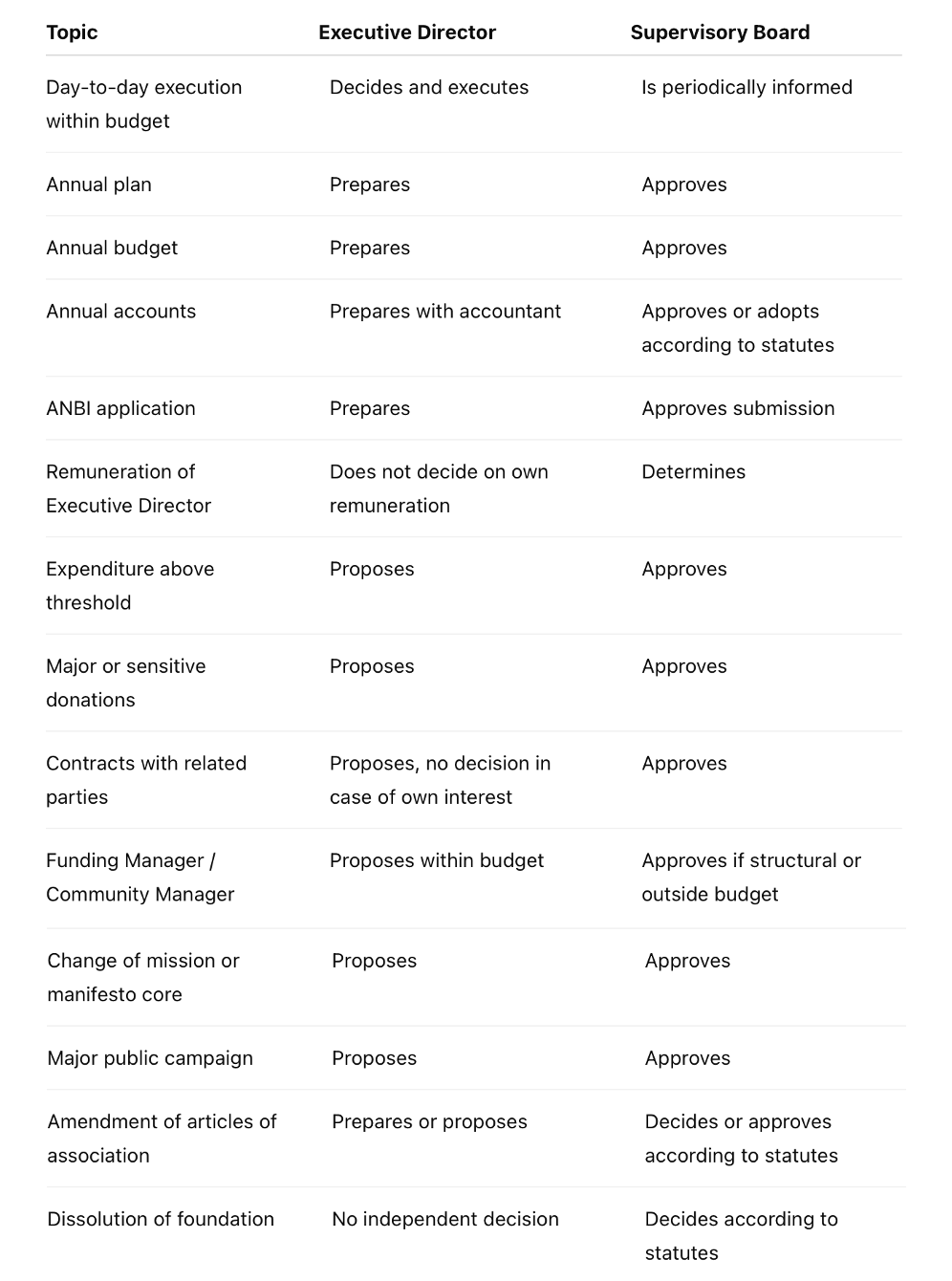
This matrix will be further developed in the executive regulations, Supervisory Board regulations and authorisation rules.
20. Risks and mitigating measures
20.1 Main risks
The foundation recognises the following risks in the start-up phase.
1. Large mission, insufficient focus
The mission is large and complex. Without focus, the foundation could become fragmented.
2. Founder dependency
The foundation originates from one founder’s initiative. This requires conscious institutionalisation and independent oversight.
3. Remuneration and conflict-of-interest risk
A remunerated Founding Director, especially if this is the founder, requires maximum transparency, objective review and clear decision-making.
4. Lack of public legitimacy
A global mission requires careful handling of representation, participation and cultural differences.
5. Reputational risk through donations or partners
Careless funding or partnerships can damage credibility.
6. Privacy risks related to signatories
Processing personal data requires careful technical and legal design.
7. Geopolitical sensitivity
The topic of war is morally and politically sensitive. The foundation must communicate carefully, independently and in a non-party-political way.
8. Financial vulnerability in the start-up phase
As a starting foundation, CWF depends on first donations and voluntary or partly paid contributions.
9. Premature professionalisation without income base
Paid roles must grow in line with realistic income and must not run ahead of structural funding.
20.2 Mitigating measures
The foundation mitigates these risks through:
- clear priorities in the policy plan;
- independent Supervisory Board;
- explicit executive regulations;
- conflict-of-interest policy;
- objective remuneration review;
- donation policy;
- privacy policy;
- transparent publication;
- annual evaluation;
- careful communication;
- external advice where necessary;
- separation of responsibilities between oversight and execution;
- accountant or administration office for financial reporting;
- AI-supported but human-approved reporting.
21. First 100-day plan after incorporation
After formal incorporation, the foundation will focus on the following actions, which it aims to realise within 100 days.
Phase 1 — Governance and basic set-up
- pass the deed of incorporation;
- register with the Chamber of Commerce;
- register UBOs;
- open a business bank account;
- establish the Supervisory Board;
- adopt policy plan 1.1;
- adopt Supervisory Board regulations;
- adopt executive regulations;
- adopt conflict-of-interest policy;
- adopt donation policy;
- adopt remuneration policy;
- adopt authorisation rules;
- set up financial administration;
- set up a decision register.
Phase 2 — Executive leadership and operational organisation
- adopt the Founding Director role profile;
- determine the contract form;
- determine remuneration only if financially responsible;
- adopt deliverables for the first 12 months;
- set up reporting cycle to the Supervisory Board;
- select accountant or bookkeeper;
- set up AI-supported reporting;
- determine when a Funding Manager or Community Manager is needed.
Phase 3 — ANBI and transparency
- prepare and submit ANBI application;
- set up ANBI publication page;
- publish objective, policy plan, oversight, executive leadership and remuneration policy;
- prepare activity report format;
- prepare financial accountability format;
- define annual publication cycle.
Phase 4 — Website, manifesto and privacy
- finalise manifesto text;
- publish manifesto page;
- finalise privacy statement;
- test signature form;
- separate manifesto signature from newsletter opt-in;
- review data processing and security;
- prepare first public communication.
Phase 5 — Community, funding and first growth
- start with first signatories;
- publish first update;
- approach first ambassadors;
- form first advisory circle;
- identify potential partners;
- build fundraising pipeline;
- prepare roadmap for the first year.
22. Evaluation and updating
The Supervisory Board evaluates this policy plan at least annually.
The evaluation considers:
- progress on the objective;
- activities carried out;
- financial development;
- quality of governance;
- functioning of executive leadership;
- growth and engagement of the community;
- donation policy and integrity risks;
- privacy and data protection;
- public legitimacy;
- relationship between execution costs and spending on the objective;
- need to adjust strategy or priorities.
The policy plan will be updated when the development of the foundation, new laws and regulations, ANBI requirements, social circumstances or strategic insights give reason to do so.
23. Closing statement
Civilized World Foundation aims to contribute to a world in which war is no longer seen as an inevitable instrument of power, politics or conflict.
The foundation starts modestly, but with a large ambition. It aims to build public awareness, systems thinking, international cooperation, moral imagination and concrete solution directions.
CWF recognises that war will not be abolished by one organisation, one manifesto or one generation. However, an independent, transparent and public-benefit foundation can contribute to a broader movement that asks the question anew:
The governance of CWF is intentionally designed for this task:
This policy plan forms the first governance for that ambition.